
Growing up as a queer kid, Umico Niwa recalls finding an unexpected kinship with crickets. To locate one another, crickets must sing loudly enough to be heard, but quietly enough to avoid detection. Niwa recognized in this precarious signaling a familiar negotiation: the desire to be seen and understood while remaining protected from those who might pose a threat.
In this conversation, the artist speaks about how the tension between visibility and concealment continues to shape a deeply personal practice rooted in grief, memory, family, and transformation. Working with foraged and perishable materials, she considers what it means today to make art that remains responsive to its environment, art that decays, and art that resists being easily preserved and collected. Moving through different bodies of work, Niwa reflects on artmaking as a form of introspection and survival. We talk about the importance of taking risks as artists, about irreverence, and about finding possibility in whatever materials are already at hand.
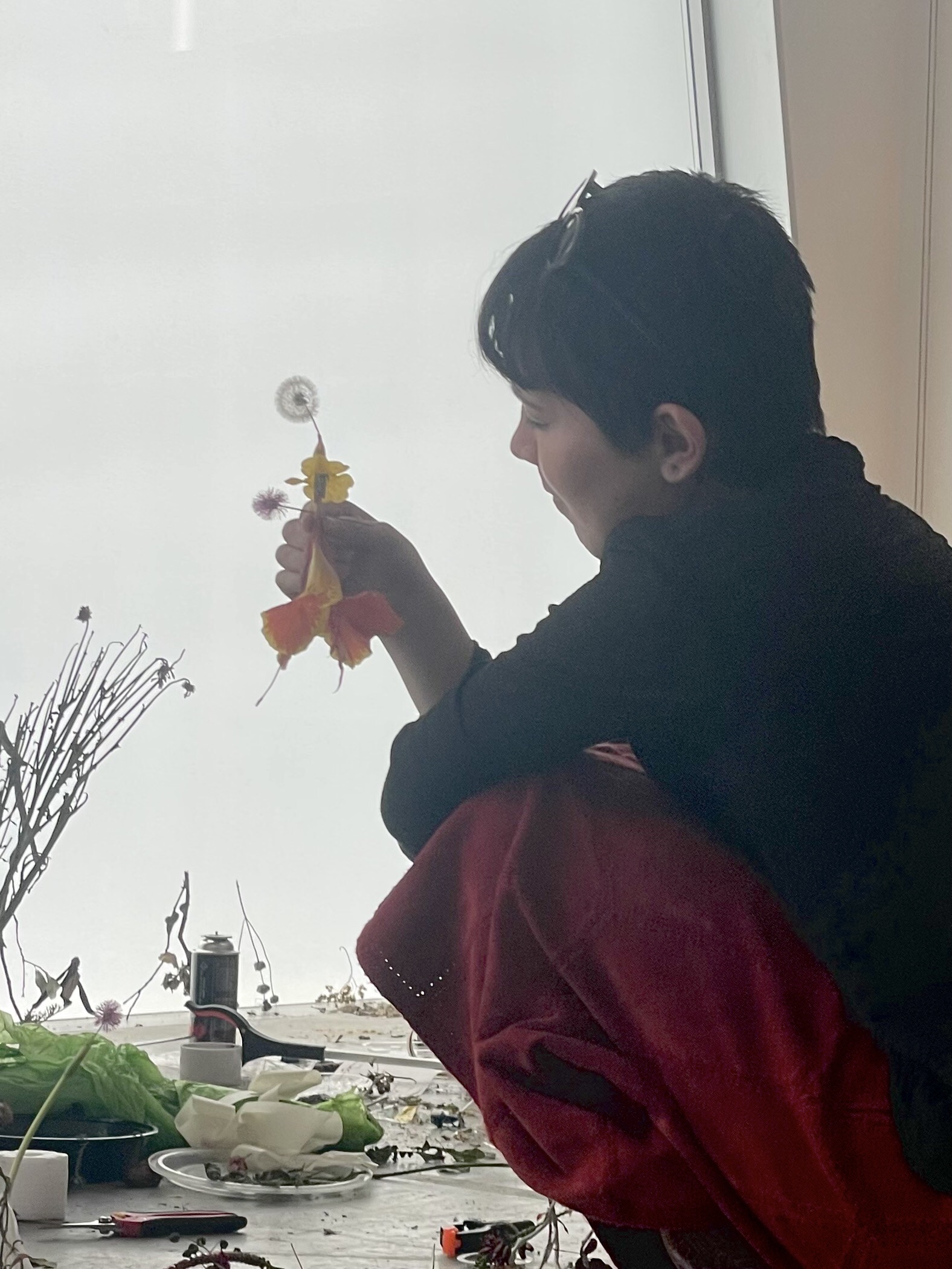
Umico Niwa received her MFA in Sculpture + Extended Media from Virginia Commonwealth University, Richmond in 2020. Rejecting Western notions of personhood, Niwa considers alternative modes of existence unbridled by bodily restrictions or gender constructs. Her creations speak to a state of being defined by perpetual movement - a flower, wilting; a fruit ripening. A seed vault, a genetic sequence, a sensorium, a somatic memory bank. A valley full of weeds, bursting with life.
Adriana Blidaru: Let’s start with the live crickets. What is the story behind them? How were you drawn to them, and what happens to them during the exhibition? What do they add to the work?
Umico Niwa: I used to keep crickets when I was in middle school because I had a bearded dragon named Eddie. They would arrive in these huge boxes, hundreds at a time. Even though the bearded dragon was technically the pet and the crickets were his food, strangely, they also became pets.
Every time I fed Eddie, a few would escape into my bedroom. My room was always infested with them. They were in my shoes before school, under my pillow, on the ceiling.
And one of the weird things I noticed was that for them to find each other and to find a mate, they would make sounds and sing, but then the louder they would sing, the more likely they were to be caught by me or also in nature, by a bird or a lizard. They had to strike this balance between singing loudly enough to find another cricket, but quietly enough not to be caught.
At the time, I was attending an all-boys middle school in the English countryside, while closeted, trans, gay, queer. I was in a very similar mindset: How do I find my allies? You’re hitting puberty and becoming more interested in the people around you, but I couldn’t tell, for the life of me, who was a fellow cricket and who was a bearded dragon.
How loudly can I signal? How can I put a frequency into the space that someone like me will notice, without being noticed by the general population? I felt this strange kinship with crickets.
And it kind of worked. I had a pin that said, “Dolphins are gay sharks,” with a dolphin jumping on it. It was innocuous enough that most people would laugh, although sometimes they would give me shit and ask, “Are you a fag? What is this?” But small things like that: the emo hairstyle swooping to one side, black nail polish - could read as punk to most people. To other kids doing the same thing, though, it was like hitting a shared frequency. It suggested they might be more receptive to queerness or femininity in some capacity.
AB: Your work feels deeply personal, especially in the way it deals with grief, transformation, and intimacy. I’d love to talk about the Elegy series, which emerged around the loss of people close to you. How does personal experience enter the work, and what did this series allow you to process?
UN: I’ve made the Elegy series twice recently - once in Berlin and, before that, at a gallery in San Francisco. Strangely, both iterations coincided with news that someone I knew in the trans community had died, either a few days before or on the day itself. I suppose making the work helped me come to terms with it.
When I made the first series, I had undergone vocal feminization surgery in Korea about a month earlier. The surgery had failed, and I was mute for two months while my vocal cords healed. Halfway through that period, during the installation, I learned that someone had died by suicide.
I was staying alone in a motel provided by the gallery. Because most of my friends were on the East Coast, in Japan, or in Europe, the time difference made communication difficult. I couldn’t call my parents or friends, and I was physically unable to speak. It was one of the most isolating experiences of my life.
In that moment, I turned to writing and sculpting, and then to incinerating what I had made. The resulting objects are strangely both stable and extremely fragile. They can remain intact indefinitely if untouched, but if you drop, shake, or crush them, they collapse into powder.
You know from the beginning that you can’t take them back to your studio or apartment. They can’t really be shipped, collected, or bought. They can exist only in that space and in that state, for as long as they remain untouched.
At the end of the exhibition, though, you have to remove them. You have to let them go; to crush them, or give them to people who try to carry them home, only for them to fall apart. That process has been very helpful to me. It has taught me how to come to terms with letting go.

AB: When you begin a work, do you respond to the site itself, or are you primarily thinking about how an existing work can inhabit the space?
UN: I rarely just ship work to a location. That partly began out of necessity. When I first started being invited to group and solo shows, many of the galleries I loved had almost no money. Instead of asking them to pay for shipping both ways, I would offer to fly there with what I could fit in a suitcase, or make the work on site, as long as they could house and feed me and cover my return flight.
That “limitation” became an important part of my practice. I might arrive with an idea of what I want to make, but after spending a week or two there, I begin to notice other things: the local plants, the history of the town or city, unexpected overlaps. It becomes a little like jazz, or a collaboration.
For me, that is more meaningful than superimposing a fixed vision onto a place, as though a sculpture could exist anywhere. I don’t think it can. There is a dance between the work and its location.
Because I often use organic matter, I usually spend several days foraging and then sculpt with what I find. That can produce strange, exciting fusions. I once lived and foraged in Puerto Rico for a month, then made a show in England. Puerto Rican vegetation met English organic matter, and the two were remixed into something entirely new.
Maybe that comes from a mestiza, biracial way of thinking. I’m drawn to fusion: cultural fusion, material fusion, something that emerges through the meeting of different places.

AB I see this in your work, it feels spontaneous and alive, but there is also a great deal of precision. I was thinking about the Metropolis series, and even more particularly Solar Processing Facility, which is incredibly intricate. How do you reconcile that meticulousness with the more fluid, improvisational side of your practice?
UN: I really like the juxtaposition of irreverence with something thoughtful and meticulous.
I often think about the house where I grew up in Japan, which my parents built with my uncle, who is a carpenter. They made this beautiful wooden house by hand, sanding and cutting every piece. Then, when I was in middle school, I drew all over the walls of my bedroom with a Sharpie.
There was something playful and punk about making that irreverent gesture across wood they had worked so carefully to prepare. I don’t think you get that same frequency: the high and the low, the peak and the valley. Not if you operate only through graffiti-like spontaneity or only through meticulous orchestration.
It’s like someone carving their name in huge letters into a red oak tree that has existed for five hundred years. I’m not condoning it, but that collision between an impulsive gesture and something ancient, carefully formed, or enduring creates an intense emotional energy.
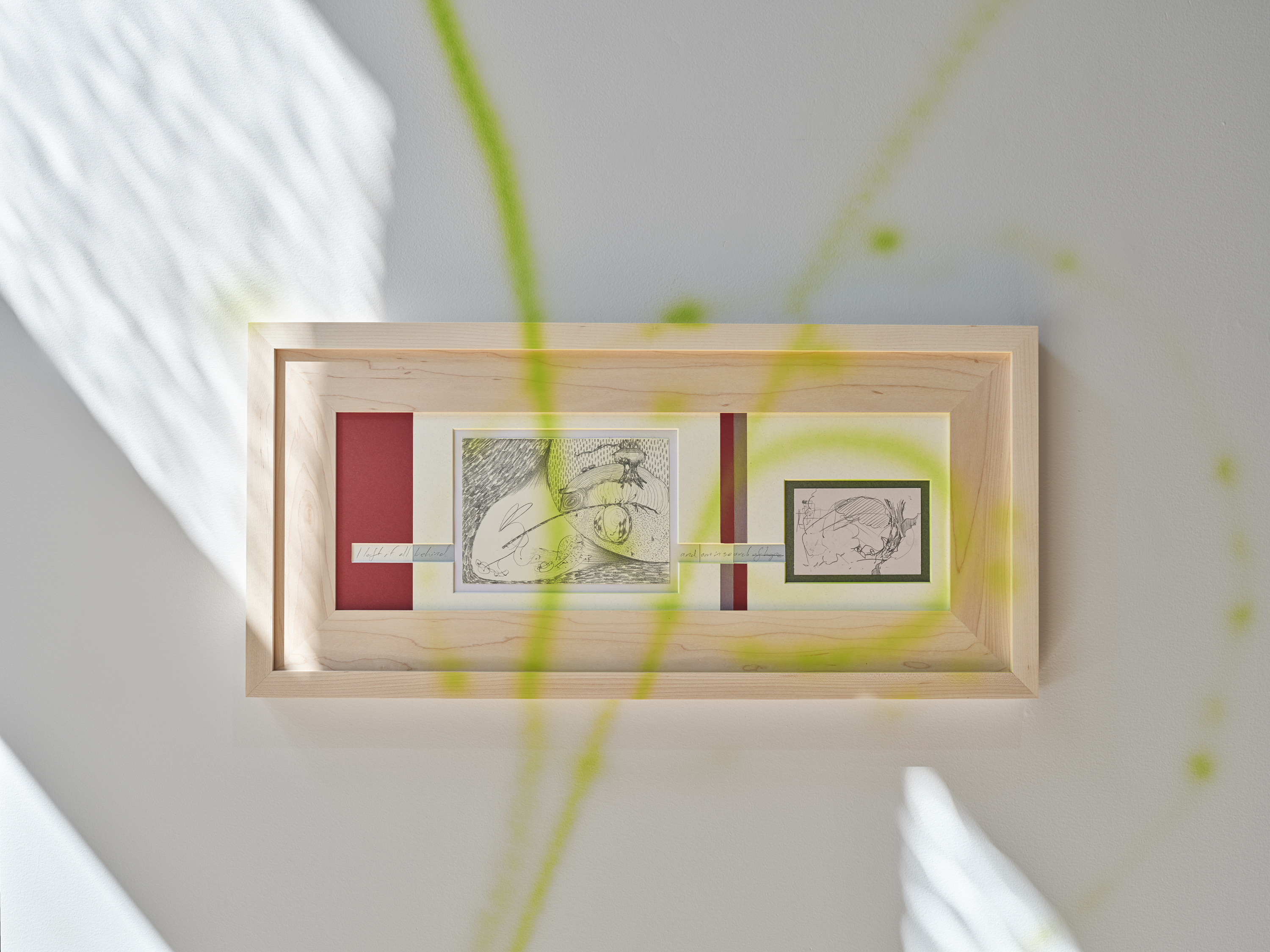
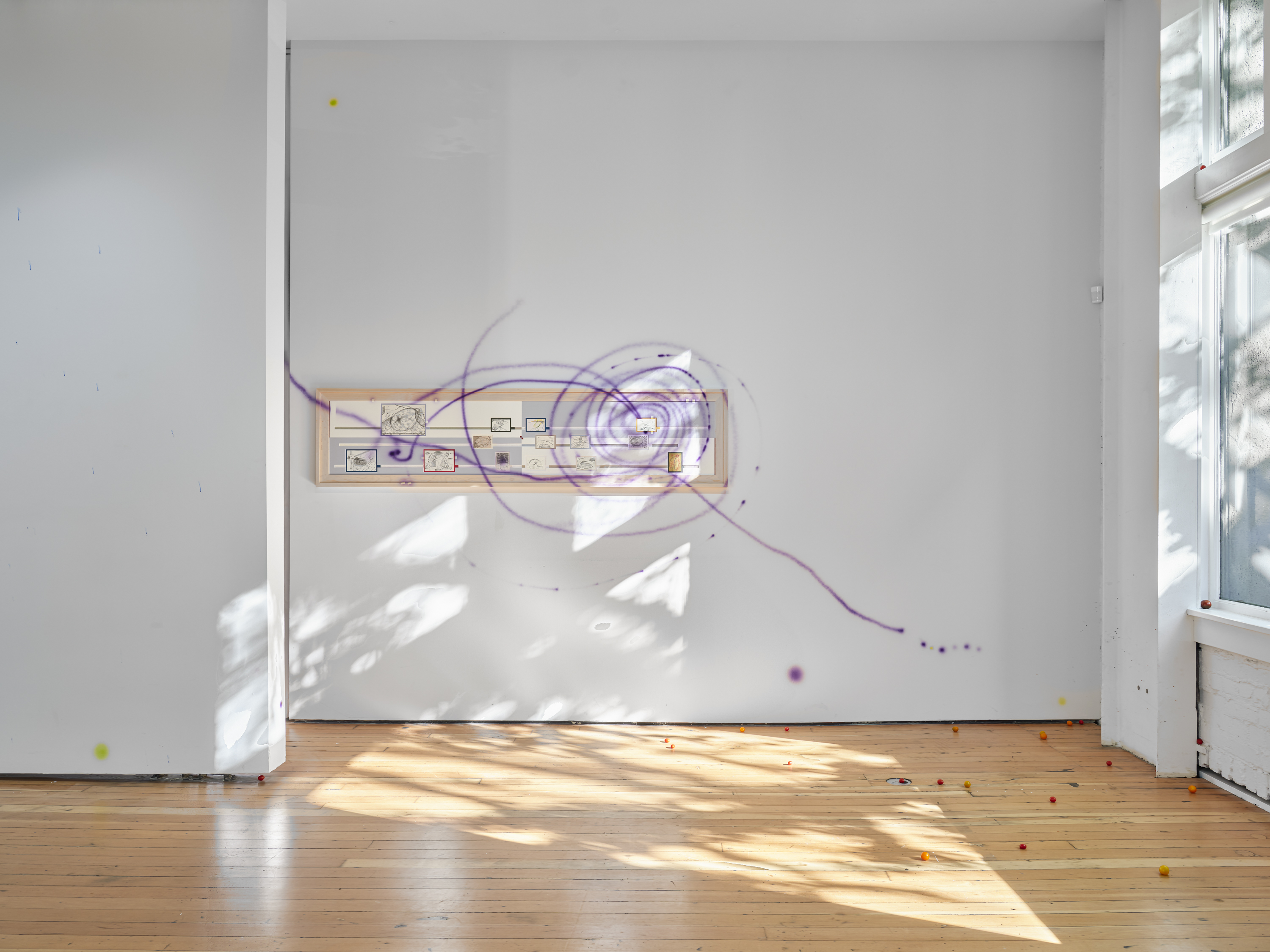
I did something similar for a recent exhibition. I had made drawings and writings on a series of carefully constructed frames. The day before the opening, after everything had been installed, I went in with an airbrush and spray paint and worked directly across them.
It was exciting because there was so much risk. The line could be bad, the color might not work with the frame, and you only had one chance to do it. That risk and irreverence activate the precision that was already there.

AB: So was that a spontaneous decision?
UN: Oh No. It was a meticulously planned spontaneous decision. There were six months of drawing, writing, making, and framing, and throughout that process I kept telling everyone at the gallery not to become too attached, because the day before the opening I was going to spray over everything.
The spontaneity enters through the doubt: Maybe I shouldn’t do it. Maybe this is already good enough. Maybe I should leave it alone. But I don’t think that makes for good work. I don’t want everything to feel too orderly. There has to be some risk.
Maybe that is partly because I don’t drink, smoke, or do drugs. This is how I take the edge off: spraying across seven framed works that the gallery is relying on selling. It keeps the work alive and allows it to change after you think it is already resolved. There is something magical about surprising yourself.
At a certain point, artists become technically capable of making exactly what they imagine. You can picture a stretched-out pink resin couch and then simply produce it. But there is no magic in that one-to-one translation.
I’ve also watched artists I admire become successful, acquire five or ten studio assistants, and work with galleries that can finance perfect production. Often, the work becomes worse. It loses that middle-school, high-school, or undergraduate ethos of: I have twelve dollars, the project is due tomorrow, and this technique isn’t working, so I have to invent some absurd tool or method to make it happen.
Once every limitation disappears, you can simply hand the idea to a fabricator and say, “Make the pink couch.” And then that is all it is.
AB: It feels like there is now so much infrastructure around art that it can destroy the fun and the spark. Especially in New York, artists are pushed to make work that is durable, archival, and sellable, while also navigating all these financial limitations. How do you resist that kind of self-policing and continue taking risks?
UN: I completely agree. I see it so much in New York. People have to work another job and can only be in their studios between ten at night and one in the morning. Then they feel pressure to make something fully archival that might actually sell, rather than following the funky, fun gut feeling they originally had.
Even after you leave that environment, if you’ve been incubated in it for long enough, your mindset calcifies. You start policing yourself: Why would I make that out of organic matter? Why would I make a sculpture out of ice cream that will melt when I could use white-painted silicone that won’t degrade and a collector can buy? By that point, I’ve already lost interest in the work.
Meanwhile, there’s a child, a teenager, or an artist somewhere else in the world who isn’t filtering an idea through five hundred different voices. They can think, I’m going to stage a fashion show in my bedroom or in an alleyway in Beijing on a twelve-dollar budget.
I think there is also an illusion that you need a studio, paper, or pencils to make art. If you need to make art in order to process something, you’ll find a rock to carve into, or you’ll carve into the floorboards. I like that cockroach mindset for an art practice: the idea that it can survive anything.
I’ve heard friends say, “I’m not making art because I’m waiting for a studio,” or, “I had to leave my studio and I’m moving, so I’m not making anything.” But you could rearrange the hairs stuck to the wall of your shower. You could sit late at night and carve into a bar of soap.
For me, it’s about using whatever is most readily available: potatoes, bananas, oranges, sticks, leaves. Unless you’re at the North or South Pole, there is almost always organic matter. And if I don’t have money, which has been true for most of my life, I just have to go for a walk.
AB: My final question is about how you move between your different series - the Metropolis series, the Elegy series, Family Staircase, aphne Adorned. How do you navigate them, both conceptually and practically? Why do the works take shape in these distinct categories, and how do you know which series comes next?
UN: Strangely, it depends a lot on what I’m working through in my personal life. If I’m working with crickets, chances are I’m in a pretty good headspace. If I’m making the Elegy series, chances are I’m in a much more depressive one.
Because so much of my work is introspective, the series become tools for helping me process things. Regardless of whether there is a viewer or an exhibition, I still need to make them. Even in the privacy of my studio or home, I think I would continue working in series. It allows me to remain with one line of thought or feeling for a certain amount of time and meditate on it.
With the Elegy series, I might work intensely for only a week or two. I don’t think I could stay with it much longer because it becomes a form of rumination. Eve Sedgwick wrote about how queer researchers and people in queer studies are haunted by the suicide of adolescence. That feeling is present in the series. From morning to night, I’m thinking about it while making and incinerating each work. If I stayed there indefinitely, I would burn out, much like the works themselves.
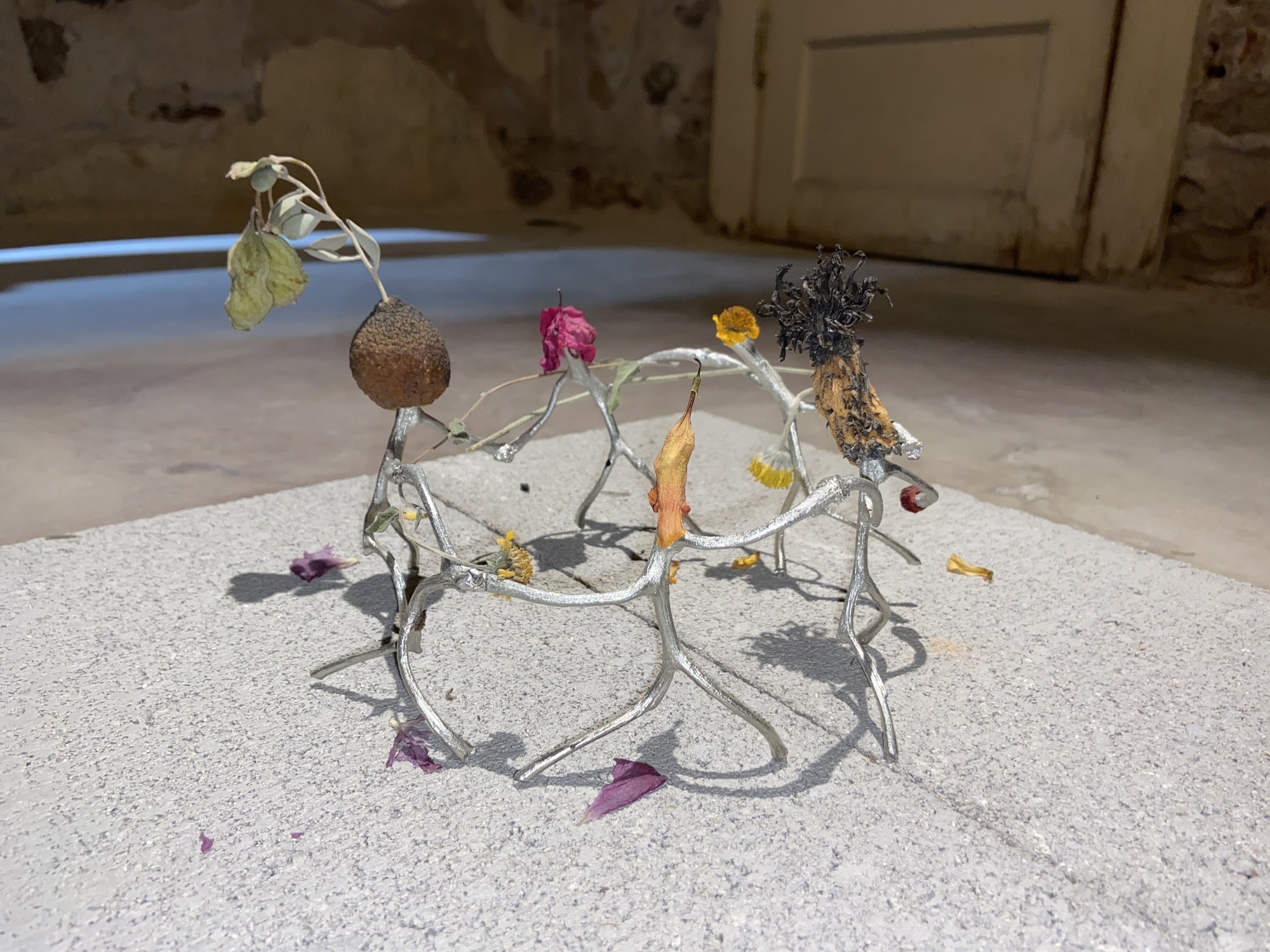
When that series is finished, I put it on the shelf and move toward something else, like Daphne Adorned or Family Staircase. Those works still deal with grief, loss, the fragility of being human and alive, and the experience of being trans, but they also contain a lot of joy.
I have fun foraging for the Daphnes, adorning them, and getting outside into nature. With Family Staircase, I make sculptures of members of my family. One sculpture of my dad shows him talking on the phone, with his hand made from a mushroom. In another, he is chain-smoking, as he used to, and his body is made from an eggplant and other organic matter.
While making them, I’m thinking about my dad, but it isn’t only painful. I’m also laughing and thinking, Oh my God, that really looks like him. I think that movement between different emotional states- between grief, rumination, affection, and joy, is why I work in series.
AB: Is there anything you’re especially excited to begin; or something you’ve just finished that feels important to you now?
UN: I’m excited to go to England for a residency soon. I’ll be searching for horses, cows, bulls, and calves that may have died prematurely, burying them in the land, and trying to find a way to record the sounds of their decomposition over nine months.
I’m so excited because it feels like it’s going to be a nightmare to figure out: legally, ethically, and technically. Those are the projects that excite me, not the ones where I’ve done something before and already know how it works.
I don’t necessarily want to mess up, but I do want to take more and more risks bigger risks. The projects might fail. Maybe someone writes a terrible review. But who cares? The possibility of having to figure out something entirely new sounds so fun to me.


